
Troy Beyond the Wooden Horse: Reading the Archaeological Layers
Look beyond the familiar legend to understand Troy’s successive settlements, museum collections and place in the Çanakkale landscape.
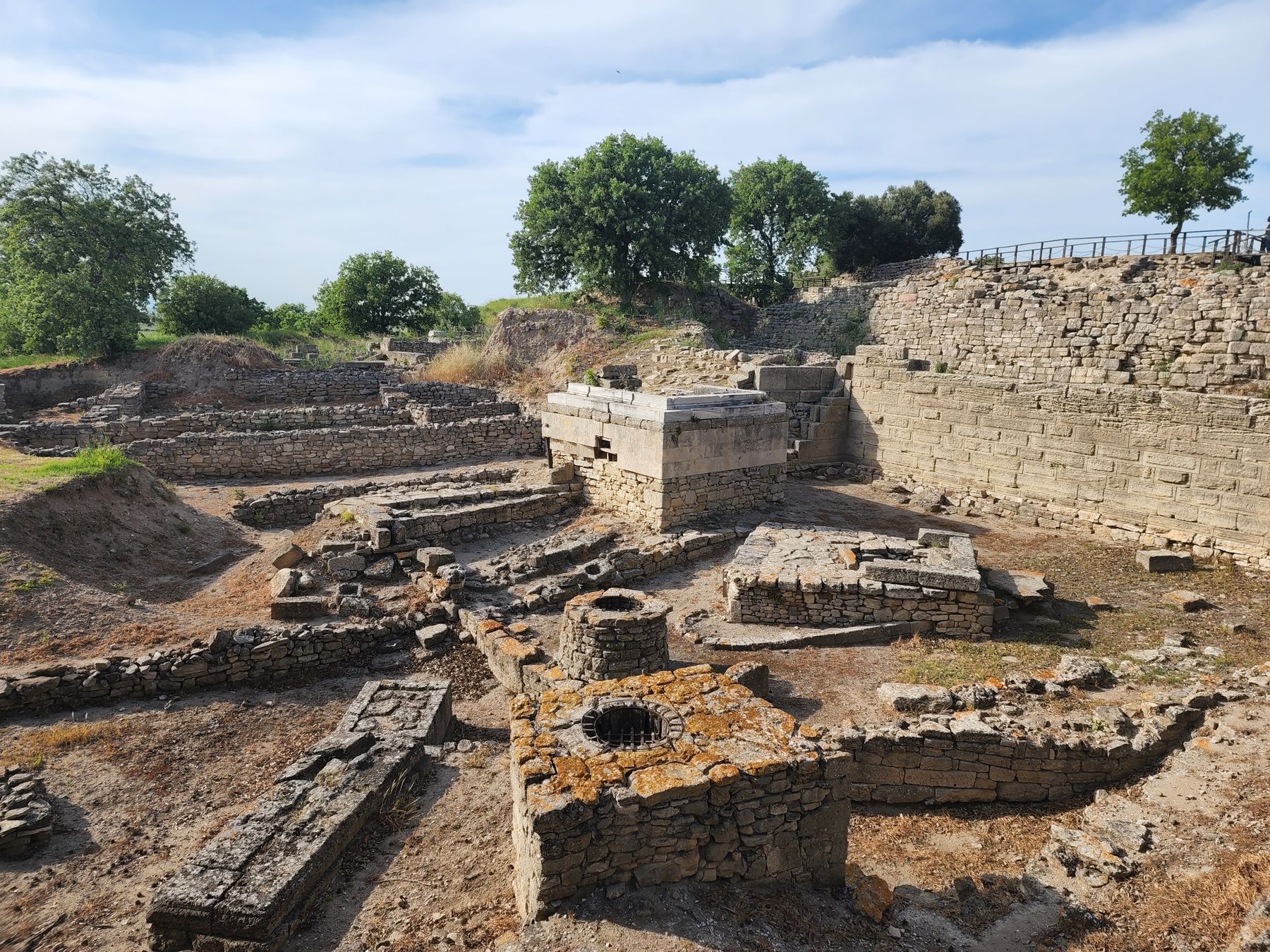
The wooden horse is often the first image visitors associate with Troy. It is a memorable way into the story, but it is not the ancient city itself. The site near Tevfikiye is a mound made by people building, altering and rebuilding a settlement over a very long period. Its walls, gateways and traces of houses are easier to appreciate when you ask which period each belongs to. A day at Troy can therefore be a lesson in reading evidence as well as enjoying an epic. This guide follows the archaeological ground first, then considers the museum and Çanakkale as useful parts of a thoughtful visit.
One place, many settlements
Troy is not one frozen city from a single moment in Homer’s Iliad. The Turkish Ministry of Culture and Tourism describes ten major settlement layers at the site, extending across more than three millennia. Archaeologists use names such as Troy I, VI and IX to separate broad phases; each phase can contain further changes. The oldest surviving levels belong to the Early Bronze Age, while later occupation continued through Greek, Roman and Byzantine periods. When you look across the excavated mound, a wall in the foreground and another behind it may be separated by centuries. Asking a guide to identify that difference makes the stones much more intelligible.
The visible remains are necessarily incomplete. Buildings were reused, materials were moved and early excavations cut through parts of the mound. A site plan can help you locate periods, but it cannot recreate every street of every settlement. UNESCO stresses Troy’s importance for understanding contact between Anatolia and the Mediterranean world. Its value is therefore wider than any attempt to match a particular wall exactly to a scene in a poem. Allow time at the first viewpoint to orient yourself: where is the mound, where is the lower ground, and how might the surrounding terrain have affected movement and defence? Those questions give the visit a clear structure.
The epic and the evidence
Homer’s Iliad shaped the way generations imagined Troy, and the story remains an important part of the site’s cultural life. Archaeology asks a different set of questions about construction, occupation, trade and destruction. The existence of an ancient settlement does not prove every detail of the Trojan War as told in literature. Likewise, the poem should not be dismissed simply because its characters cannot be identified in a trench. A careful guide can hold the two perspectives together: explain the story people came to hear while showing what the material record can and cannot tell us. That distinction makes the experience richer rather than less dramatic.
The horse at the archaeological entrance is a modern interpretation, not an excavated Bronze Age object. Türkiye’s Ministry of Culture and Tourism says the sculptor İzzet Senemoğlu made it in 1975 using pine from the Kaz Mountains. It is an enjoyable orientation point, especially for a first photograph, yet it should not determine the whole route. Afterward, look for the surviving fortifications, changes in masonry and the relationships among excavation areas. If a feature’s date is uncertain, let it remain uncertain. Archaeological interpretation changes as research advances, and resisting a neat but unsupported claim is part of seeing Troy honestly.
Why the landscape matters
UNESCO describes evidence for a lower city south of the mound, extending over a substantial area in the Late Bronze Age. That finding helps counter the misleading idea of Troy as only a compact citadel on a hill. From a suitable viewpoint, consider how the elevated core related to the terrain below it and to routes across the wider region. The present coastline is not a simple map of ancient access. Rather than imagining a ship directly beside every wall, use the landscape to ask how geography, exchange and protection might have mattered across different periods. This is a question to explore with evidence, not a fixed scene to impose on the ground.
The Troy Museum as a second chapter
The Troy Museum stands by the archaeological site at Tevfikiye. Its official presentation connects objects from excavations with the wider Troas region, the Bronze Age, the Iliad, later antiquity and the history of archaeology. Visiting the museum before the ruins gives you a vocabulary for layers and objects. Going afterward lets you test what you saw outside against the displays. Either sequence works, but it is worth giving the museum real time rather than treating it as a shop attached to the site. Labels, maps and objects can answer questions that bare foundations leave open. They also show that Troy belongs to a regional history, not only to one literary episode.
Çanakkale without confusing the horses
CREAOS Travel’s published Troy route also includes time in central Çanakkale. A second horse sculpture stands by the waterfront there, separate from the horse at the archaeological entrance. A short promenade walk can be a pleasant end to the day, but keep the two locations distinct when reading photographs or planning transport. The city stop offers a change of pace after the exposed archaeological ground and the concentrated museum visit. It need not become a rushed checklist. If time is limited, decide whether archaeology, museum interpretation or an unhurried meal matters most to your group, then build the route around that priority.
Planning a comfortable visit
The present CREAOS Troy tour lists private transport and professional guiding; its description excludes meals and archaeological admission. Confirm the exact services and current entry arrangements in a written proposal for your date. Opening hours, ticket rules and exhibitions can change, so check official museum channels shortly before travel. On the site, expect outdoor walking and uneven surfaces; choose supportive shoes, carry water and discuss mobility needs before booking. A guide can help adjust the pace, but not erase the terrain. If arriving on a ship, allow realistic road time and a return margin. Avoid promising that every optional stop will fit into a short port call.
A better question to take home
Troy rewards the visitor who leaves with a question rather than a single image. Which remains belong to a different settlement? How does an excavated object change the way a foundation looks? Where does an epic illuminate cultural memory, and where must archaeology speak in its own voice? UNESCO listed the Archaeological Site of Troy as World Heritage in 1998, recognising a place of exceptional historical and cultural depth. Read the mound, explore the museum and let Çanakkale provide a human scale for the day. The wooden horse will still be there; it simply will no longer be the only story you remember.