
Priene, Miletus and Didyma: Three Ways to Read the Ancient Aegean
Read a planned hillside city at Priene, a shifting former port at Miletus and the sacred landscape of Apollo at Didyma. A thoughtful guide to three distinct sites on one Aegean route.
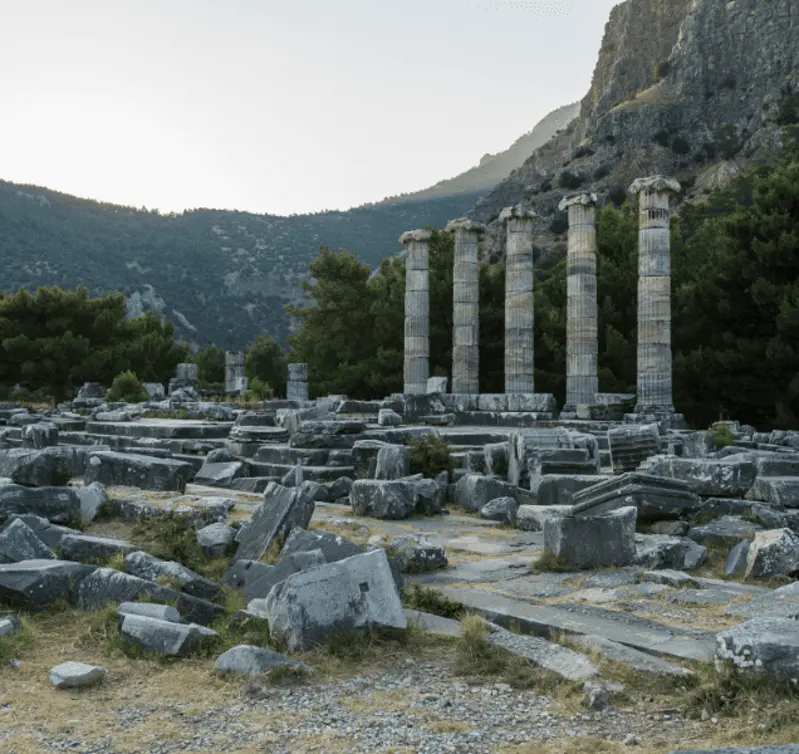
Priene, Miletus and Didyma often appear together as three stops on a single Aegean day. Their proximity is useful, but it can also hide what makes each place different. At Priene, streets and public buildings make urban planning visible. At Miletus, a former port invites you to imagine a coastline that no longer looks the same. At Didyma, monumental architecture served a sacred and oracular purpose rather than the ordinary needs of a city. The best way to connect them is to carry a different question into each visit. This guide offers a route through three kinds of place, with enough context to make the spaces more meaningful than a checklist of ruins.
Priene: read the hillside as a city plan
Priene stands near Güllübahçe on the southern slope of Mount Samsun, according to the Aydın Provincial Directorate of Culture and Tourism. The terrain matters as much as any famous column. The Turkish Museums portal describes a grid of streets adapted to the slope, with steps on many of the side routes and public buildings gathered toward the centre. As you walk, notice how a clear geometric idea meets uneven ground. A plan drawn on paper can seem abstract; in Priene you experience its choices with your feet. Stop at a junction, look both ways and ask where public life would have drawn people from the residential blocks.
The sanctuary of Athena, theatre, agora and council building illuminate different activities within the same urban order. A temple organised sacred life; the agora provided a civic meeting place; the bouleuterion suggests how decisions were made. Rather than treating them as interchangeable “Greek ruins”, compare their positions and the paths between them. The official museum description calls Priene a remarkable example of ancient planning while also acknowledging that the city's earliest foundation is still uncertain. Those statements belong together. We can learn a great deal from the remains of the visible settlement without pretending that every question about its beginnings has a settled answer. A good guide makes such limits part of the story.
Miletus: what happens when the shoreline moves?
Miletus can be difficult to reconcile with the idea of a great port when you look at the present landscape. The Ministry of Culture and Tourism explains that sediment carried by the Büyük Menderes River gradually changed the city's connection to the sea. Today's view should therefore not be mistaken for a fixed image of the ancient coast. The theatre and public buildings speak to the scale of the settlement, but the missing water is also part of the story. Think of the landscape as evidence of change, not merely a backdrop. A city that once depended on maritime links had to live through transformations in both its environment and its political world.
If the day's timing allows, the Miletus Museum deserves more than a last-minute glance. The provincial culture authority says that its displays bring together material from Miletus, Priene and the Temple of Apollo at Didyma. Small objects, dedications and architectural pieces can connect the three sites at a different scale from the monumental remains outside. A museum case may answer a question raised by a building, or reveal how much still cannot be inferred from walls alone. Plan the museum as a deliberate part of the itinerary if that interests you. Check current admission arrangements and opening information with the official museum service close to your visit, because practical details can change.
Didyma: a sanctuary rather than a conventional city
At the Temple of Apollo in Didyma, change the way you read the ground. The Aydın Provincial Directorate of Culture and Tourism explicitly describes Didyma as a sacred precinct rather than an ancient city in the ordinary sense. It was linked to Miletus by a sacred road and was known as an oracular centre. Its purpose differs from a residential street grid or a port's marketplace. The enormous columns are impressive, but size alone is not the most interesting observation. Consider how a visitor would approach, enter and move through the precinct. Changes in level, enclosure and scale helped turn a journey toward the sanctuary into an experience of anticipation.
The official account traces the sanctuary's prominence in the Archaic period, its destruction in 494 BCE and renewed building from 311 BCE. Construction continued with changes into later eras, and the temple was never fully completed. Incomplete does not mean insignificant. The surviving fabric offers a rare way to think about ambition, interruption and continuity at once. Avoid relying on rankings such as “the world's third-largest temple” when the criteria are unclear; the more useful story is the relationship with Miletus and the long life of the oracle. Looking closely at masonry and circulation reveals how a sacred institution could shape a place across centuries without ever reaching a final, finished state.
Planning a thoughtful three-site day
A day beginning in Kuşadası, Söke or Didim can potentially connect all three places, but the quality of the visit depends on your pace. Priene calls for uphill walking; Miletus asks you to cover open ground; Didyma benefits from time spent studying details around the sanctuary. Your starting point, transport and choice of guide affect the route. Adding the museum or a leisurely lunch means adjusting the rest of the schedule rather than pretending time is unlimited. Check official site information shortly before departure instead of treating an old travel article as a reliable timetable. Cruise visitors should also confirm their return arrangements separately; no generic itinerary can guarantee a particular ship schedule.
The day may leave you with three strong images: Priene's streets fitted to a slope, Miletus facing a transformed landscape and the unfinished scale of Apollo's sanctuary. The deeper reward is understanding why those images belong together without collapsing them into one story. The same region held planned civic space, a shifting maritime world and a centre of sacred travel. CREAOS Travel's Priene–Milet–Didyma route can be adapted around the questions that most interest you, whether you favour archaeology, museum collections or a slower journey. Treat the published route as a starting point; guiding, transport, timing and other inclusions should be agreed in a proposal for your travel dates.