
Aphrodisias and Laodicea: Reading Two Ancient Cities Together
Follow marble carving, civic life and early Christian heritage across Aphrodisias and Laodicea, with Pamukkale as a distinct third chapter.
Why compare these two cities?
Aphrodisias and Laodicea reward a journey together because they do not tell the same story. In the Karacasu area of Aydın, Aphrodisias is known for marble sculpture and the sanctuary of Aphrodite. Near Denizli, Laodicea speaks through its urban plan, commercial setting and early Christian associations. Rather than collecting two sets of ruins, carry the same questions between them. Where did civic wealth come from? How did public spaces organize life? How did religious uses change over time? If Pamukkale and Hierapolis also belong to your itinerary, allow that landscape its own context.
Begin Aphrodisias with its marble
UNESCO defines the Aphrodisias World Heritage property as both the ancient city and the marble quarries northeast of it. Reliefs, statues and richly decorated buildings were linked to a nearby source of stone and to artisans who developed distinctive skills. Marble was more than a construction material; it was central to the city’s place in the Roman artistic world. Move between the open site and the Aphrodisias Museum with this relationship in mind. Look closely at how a face is carved, then notice the treatment of ornament on a gateway. The sanctuary of Aphrodite matters, but so do the people who shaped these works.
Pause at the Tetrapylon
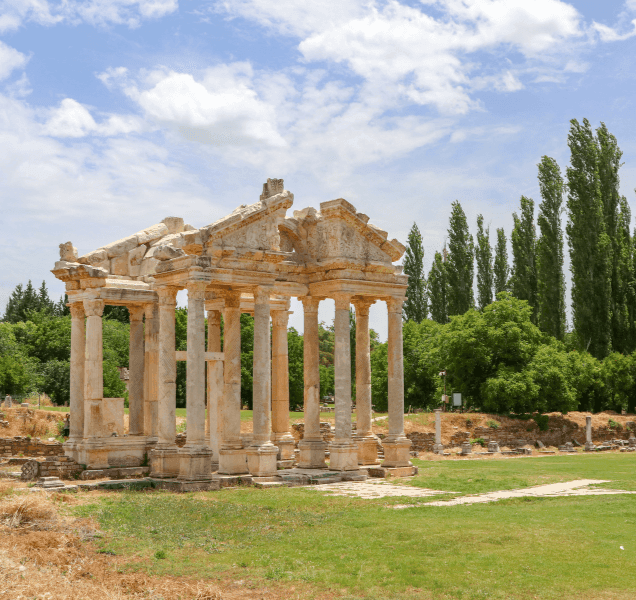
The image accompanying this guide shows the Tetrapylon, the monumental gateway to the outer sanctuary of Aphrodite. UNESCO singles out its elaborate carved ornament among the distinctive features of the site. Ask what such an entrance prepared a visitor to experience. The stonework directs attention, while the space beyond it supplies context a photograph cannot show. Notice the path and nearby buildings before moving on. Conservation shapes what survives today; a standing monument is not a transparent window into a single ancient moment. Comparing its decoration with museum sculpture connects the gateway to the city’s wider craft traditions.
Compare stadium and Sebasteion
The stadium and Sebasteion reveal different public languages within the same marble city. UNESCO describes the stadium, with its curved ends, as an exceptionally well-preserved example of its type. Think about its scale, seating and sightlines: this was a space organized for crowds. The Sebasteion was an imperial cult complex whose sculpture joined politics, religion and art. Ask what the reliefs represented and who was expected to read them. One monument emphasizes collective spectacle; the other uses imagery and architecture to express power. Reading function and visual language separately makes the city more legible.
Look for change across centuries
The Temple of Aphrodite was later converted into a church; UNESCO places this transformation around AD 500. That date does not mean everyone changed beliefs at once. A building’s altered plan, its earlier sacred role and the memory of a cult belong to different processes. Consider which parts reflect an earlier arrangement and which speak to later use. A neat “before and after” account can hide the complexity of an inhabited city. Early Christian heritage at Laodicea belongs to a different urban story, even though both places preserve evidence of religious change.
Approach Laodicea as a city
The Denizli Provincial Directorate of Culture and Tourism places Laodicea roughly six kilometres north of the modern city, in the Lycus valley. Roads, exchange and water mattered alongside monuments. The archaeological area includes theatres, a colonnaded street, water structures and church remains. If you view it only as a religious stop, commerce and daily routines disappear. If you see only masonry, its place in Christian history becomes harder to understand. Notice distances between structures and how public areas fit together. The remains are not a single diagram built at one moment for one purpose.
Read the Seven Churches carefully
Laodicea is associated with one of the seven communities addressed in the Book of Revelation, a connection also noted by the Denizli provincial cultural authority. “Seven Churches” should not be read as a promise that seven original buildings stand intact today. The communities named in the text, the dates of excavated buildings and the condition of visible remains are separate questions. At the church area, ask what archaeologists have established about the structure and which period its different parts represent. A city’s appearance in a sacred text does not make every surviving stone contemporary with that text. Keeping these distinctions clear respects visitors who come for religious history and those interested in archaeology, while avoiding a simple but misleading story.
Give Pamukkale its own chapter
The related CREAOS tour brings Aphrodisias, Laodicea and Pamukkale-Hierapolis within one broad route. Hierapolis and its thermal landscape offer a different set of questions from either of the first two cities. Treating Pamukkale only as a closing photograph would flatten that difference. Aphrodisias invites attention to sculpture and a sanctuary; Laodicea to urban and early Christian layers; Hierapolis to a city shaped by its setting beside the travertines. Their relationship can make a journey richer without making the places interchangeable. Before agreeing on a route, ask the travel team to confirm current access, transport and the parts that best match your interests. Proximity on an itinerary does not guarantee the same visiting pace at each site.
Practice a slower archaeological reading
At both sites, begin with the overall plan and then choose a few structures to examine closely. Respect conservation boundaries; understanding a relief does not require touching it. Light may make a compelling photograph, but interpretation panels and museum objects often explain what the frame leaves out. Reconstructions can help the mind complete missing portions, yet they should not be mistaken for direct images of antiquity. Ask which elements are ancient, which have been conserved and which have been reassembled. Opening conditions, accessibility and permissions can change, so consult the relevant institutions before travel. This guide does not promise entry to every feature or a fixed schedule. Careful preparation lets the historical questions, rather than logistical surprises, lead the day.
What should remain after the visit?
Carry away two distinct urban characters rather than a long list of monument names. At Aphrodisias, remember the quarries, the sculptors and the sanctuary gateway. At Laodicea, remember the valley setting, civic spaces and an early Christian layer. Their common thread is not one religious label but the changing uses of cities over time. At the Tetrapylon, ask what an entrance meant to an ancient visitor; on a Laodicean street, ask how a city connected its different activities. The CREAOS Aphrodisias-Laodicea-Pamukkale tour offers one possible route. The Pamukkale destination guide gives the third place more room to speak. Confirm the current program and visiting arrangements before booking, and let each site retain its own story.