
Basilica Cistern: Reading Istanbul’s Water Story Underground
Look beyond the reflections at Basilica Cistern and trace the water infrastructure that helped sustain historic Istanbul.
A different city beneath the pavement
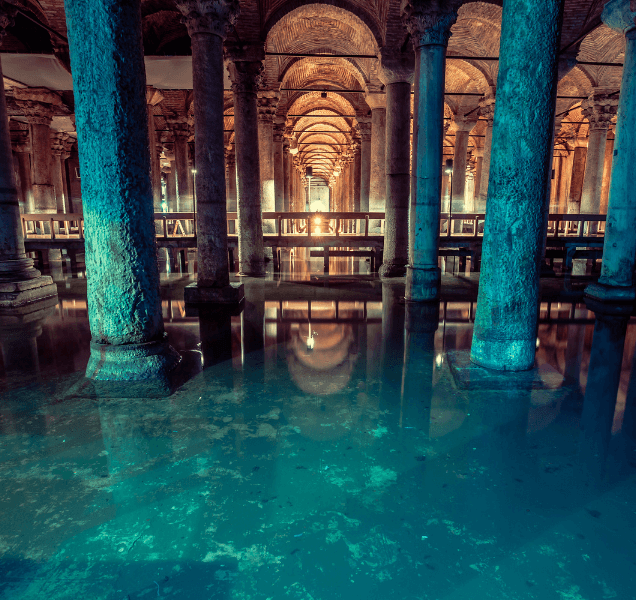
Walking through Sultanahmet, you can miss one of the most practical questions in Istanbul’s history: how did a crowded capital obtain and store water? Basilica Cistern offers a way to ask it underground. The columns, vaults and reflecting surface make a memorable first impression, but they were parts of a working reservoir rather than a stage designed for visitors. Istanbul’s provincial culture and tourism authority defines cisterns as waterproof spaces built to hold water. Begin with that purpose before reaching for your camera. It will change what you notice in the room and how you read the streets above.
Why was the cistern built?
The provincial culture and tourism authority and the museum’s own publication place Basilica Cistern in the sixth century, during the reign of the Eastern Roman emperor Justinian. The museum explains that it supplied the Great Palace and nearby buildings. That detail connects a spectacular monument with ordinary urban needs. A palace, its surrounding district and the people serving them could not function without a dependable water supply. Infrastructure is often hidden behind accounts of emperors and monuments. Here it is the monument. As you walk, ask what problem the building solved instead of treating it as an isolated marvel.
Look beyond the column count
Official descriptions record 336 columns supporting the cistern’s vaults. The number communicates scale, but standing among the rows conveys something more useful: repeated supports made a vast covered reservoir possible. Compare a nearby capital with one farther away. The museum publication describes Corinthian examples alongside simpler capitals, while the provincial authority notes the brick floor, waterproof wall coating and vaulted covering. These details served engineering as well as appearance. A label such as “ancient columns” cannot explain the range you see. Slow down enough to observe their forms, then return to the practical task of holding a great volume of water.
The Medusa heads without invented certainty
Two carved Medusa-head blocks have become the cistern’s most photographed details. The museum identifies them as architectural elements reused from other structures and placed beneath columns. Their different orientations invite stories, and a guide may discuss the legends that grew around them. Keep those stories separate from a documented explanation of their original placement or the builder’s intention. The visible fact is already compelling: material from another context acquired a new structural role. Looking at the blocks as reused stone, rather than as a solved riddle, makes the cistern part of a longer urban history of repair and adaptation.
Follow the water, not just its reflection
Present-day lighting makes the water surface a powerful visual feature. It should also remind us why this space exists. Cisterns belonged to a network that moved water, stored it and made it available where it was needed. The provincial authority explains that water reached Istanbul’s cisterns through supply channels. The museum’s publication associates Basilica Cistern with the Hadrianic water line. You do not need to reconstruct every pipe to understand the larger idea. Imagine the journey from source to city, then from conduit to reservoir and onward to buildings. The reflected columns become evidence of a system rather than only a photograph.
Compare the Theodosius Cistern
Basilica Cistern is not Istanbul’s only surviving water store. The provincial culture and tourism authority dates the Theodosius Cistern, also known as Şerefiye, to the fifth century and places it within the historic water network. The two sites need not be visited on the same day for the comparison to matter. Mark them on a map and consider how separate reservoirs could serve a growing city at different moments. If you do plan both, check each operator’s current visitor information independently. Different opening conditions, displays and travel times can shape the route. A comparison of structures is more rewarding than a race to tick off underground attractions.
Take photographs with care
The first minute underground is worth spending without a screen. Give your eyes time to adjust, find the rhythm of the columns and listen to the room. Then photograph a whole row before concentrating on a single detail. Leave clear space on the visitor walkway, and do not lean across barriers to obtain a different angle. Rules concerning flash, tripods and commercial photography can change; check the operator’s current guidance and on-site signs. A photograph of reflected light is attractive, but one that also shows how the columns support the vaults can tell more of the building’s story.
Plan around current access
Visitor hours, tickets and access arrangements should be checked on the Basilica Cistern Museum’s official site close to your travel date. Underground conditions, platforms and crowds may affect different visitors in different ways. If step-free access or other support matters to you, confirm the details with the operator rather than relying on an old travel post. Sultanahmet has several major sites, and it is easy to overfill a day. Give the cistern enough unhurried time for both observation and interpretation. Families can prepare children for low light, water and busy passages. These practical choices improve the quality of the historical visit.
Place it within a CREAOS journey
CREAOS lists Basilica and Theodosius cisterns in its “Istanbul Underground Passages Tour.” The tour description also mentions other subterranean spaces. Ask which areas are actually open on your chosen date, what order the visits will take and which admissions are included before booking. A private route can spend more time on engineering, reused architectural fragments or the shape of the old city, depending on your interest. It should not promise access to a closed passage merely because a story about it is appealing. A clear, feasible itinerary is a better guide to Istanbul below street level.
Bring the story back above ground
When you climb into daylight, do not leave the cistern as a separate, mysterious world. The palace district, surrounding streets, conduits and distant aqueducts all belong to a city that had to manage water. The provincial authority and the museum provide grounded historical context; the museum operator provides the most relevant current visitor information. Keep those two kinds of information distinct. The lasting memory may be a Medusa photograph, but the more useful takeaway is a question: which other essential systems hide behind the monuments we call a city’s main attractions? Basilica Cistern gives that question a powerful place to begin.