
Following Saint Paul in Türkiye: Reading the Places Behind the Route
Explore Perge, Pisidian Antioch, Konya and Tarsus while distinguishing ancient cities, later memorials and traditions along a meaningful journey.
A route with several layers
Following Saint Paul across Anatolia does not mean visiting a chain of buildings left untouched since his lifetime. The streets of Perge, the site of Pisidian Antioch near Yalvaç, ancient Iconium beneath modern Konya and memorial places in Tarsus belong to different historical layers. At one stop you read an ancient city plan; at another you consider a community named in a religious text; at a third you encounter a tradition formed much later. The journey becomes more rewarding when those distinctions remain clear. This guide offers questions to carry into the CREAOS Saint Paul tour. It does not claim that every modern road follows Paul’s exact path, or that every visible monument stood in his day.
See Perge as a city first
Near Antalya, Perge is a broad archaeological landscape with organized streets and public buildings. The official museum account also connects Paul’s travels through Perge with the onward journey to Pisidian Antioch. Yet it would be misleading to treat every surviving monument as direct evidence of that visit. Read the Roman urban fabric, changes in its use and later basilicas on their own terms. Along a street, first ask how water, commerce and people moved through the city. Then ask why this landscape matters to the Pauline account. That order gives the place a history beyond its role in one biography. It also helps you notice the difference between a literary reference and the physical date of a standing structure.
Place Antioch near Yalvaç
Pisidian Antioch is the ancient city near present-day Yalvaç, not another city with the same ancient name on the Mediterranean coast. The Isparta provincial cultural authority documents its location and historical setting. Paul’s address there holds a special place in Christian tradition. On the archaeological site, however, resist the urge to search for just one religious marker. Look at the town plan, civic spaces and traces of later occupation as well. A city mentioned in a text and the buildings now preserved there need not belong to precisely the same years. Ask your guide which details come from written accounts, which from excavation and which from later interpretation. That simple distinction can make a familiar story much richer.
Read Iconium within modern Konya
The New Testament narrative places Paul and Barnabas in Iconium, the ancient name associated with present-day Konya. Walking through a living city does not mean that a visitor can trace their movements stone by stone. Nor should the Pauline layer erase Konya’s Seljuk, Ottoman and contemporary heritage. The fact that a place has served different communities in different centuries is part of its appeal. Recognizing the setting of an account and seeing a surviving monument from that account are separate experiences. Before selecting a Konya stop, ask which museum or neighbourhood best matches your interests. An honest visit makes room for historical distance instead of compressing the entire city into one episode.
Separate memorial from antiquity in Tarsus
Tarsus is remembered as Paul’s birthplace. The Saint Paul Memorial Museum visited there is not a church surviving from his lifetime. Türkiye’s official museum record dates the present building to 1850, when it was erected by an Orthodox Arab-Greek community; it was restored in the modern period. That date does not make the place less meaningful. It shows how later generations chose to remember a much earlier figure. As you walk around Tarsus, carry the same question from site to site: what belongs to antiquity, what to subsequent worship, and what to the experience of visitors today? Naming these layers makes the city more interesting than a simple claim that one structure contains a personal trace of Paul.
Approach Saint Paul’s Well as tradition
Saint Paul’s Well is another memorial stop associated with Tarsus. Official tourism information introduces it within the local tradition that links the place with Paul. A tradition maintained around a site is not the same as an archaeologically established personal connection. There is no need to hide that distinction. Local memory is itself a real part of travel: why do communities remember particular lives at particular places? Consider the well alongside the museum and the streets of Tarsus. Together they reveal how the city tells Paul’s story, rather than offering one simple piece of proof. Check current access and visitor arrangements through the relevant institution before setting out; this guide makes no promise about a particular opening day.
Give Cappadocia a separate chapter
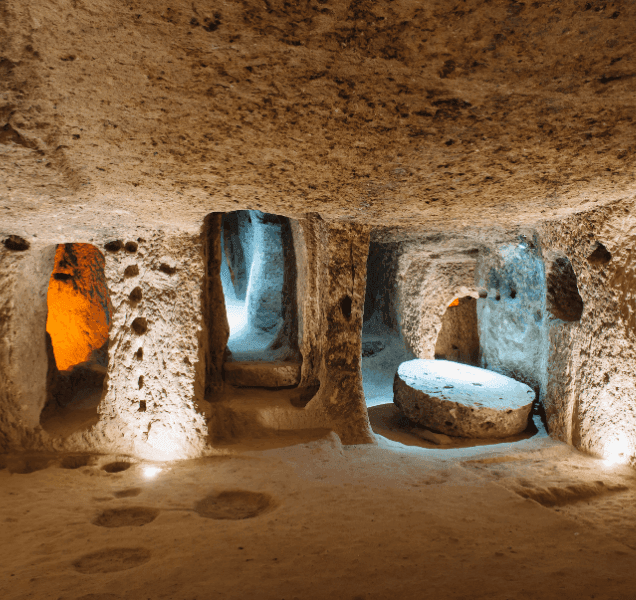
Cappadocia also appears on the related CREAOS journey. Its rock-cut churches and Christian heritage should not be described as a literal extension of Paul’s passage between Perge and Antioch. The region opens a different chapter in the wider and often later history of Christianity in Anatolia. UNESCO’s account of Göreme and Cappadocia draws attention to the relationship between the carved spaces and the surrounding landscape. In a painted church, ask about the building’s own period and the images you see. Do not place every Christian site named on a tour into Paul’s lifetime. The route then grows beyond one person’s biography into a more layered account of faith, art and changing places.
Look carefully on site
At an archaeological site, start with the overall plan and then study two or three structures closely. Compare dates on interpretation panels; ask a guide to distinguish ancient material, conservation work and reconstruction. Do not assign the same certainty to a scriptural account, an excavated object and a local tradition. Respect protection boundaries, avoid touching decorated surfaces and leave room for those who use a place for worship or quiet reflection. Museum hours, roads and access conditions can change. Consult current announcements from the relevant institutions rather than treating an old travel description as a guarantee. A flexible program creates space to observe rather than rush from one named stop to the next.
Build the journey around your question
Before travelling, decide which thread interests you most: Paul’s life, Roman cities, early Christian communities, or later religious art in Anatolia. The answer can guide how much time you give each place. The CREAOS Saint Paul journey provides a starting framework across Perge, Pisidian Antioch, Konya, Tarsus and Cappadocia. Our Cappadocia destination guide helps you explore the final region on its own terms. Confirm the actual route, transport, access and inclusions with the team before booking. Aim to leave with more than the phrase “Paul was here.” At each stop, ask what is documented, what is commemorated and what remains a matter of interpretation. That is a more lasting way to read a route across centuries.