
Havra Street in İzmir: Jewish Heritage in the Living Kemeraltı Market
Walk Kemeraltı’s Havra Street with care: understand İzmir’s synagogue cluster, trading city, changing buildings and the practical limits of interior access.
Begin in the working city
Izmir’s Jewish heritage is easier to understand when Kemeraltı is treated as a living market district rather than a collection of locked monuments. The provincial Directorate of Culture and Tourism places several historic houses of worship around Havra Sokağı, or Synagogue Street, and the adjoining lanes. A walk should begin with that compact geography. Notice how a place of worship can stand behind a courtyard wall while commercial life continues immediately outside. This is a different story from the Istanbul neighbourhoods in our earlier guide: here the port city and the market are the thread connecting community, architecture and daily life.
Use the port as historical context
Izmir’s growth as an Ottoman trading port brought people and goods from several directions. The provincial tourism authority links the expansion of the Jewish community from the early seventeenth century with migration into the port city. Families settled near Havra Sokağı, İkiçeşmelik and the Agora area, while later communities also lived elsewhere. That context helps explain why several synagogues appear within a relatively small walk. Their proximity is not evidence that all were founded at the same time or served an identical congregation. Each building has its own history, adaptations and present-day use. A guide should make the city’s trading geography visible without reducing a community to its economic role.
Find Havra Sokağı without rushing
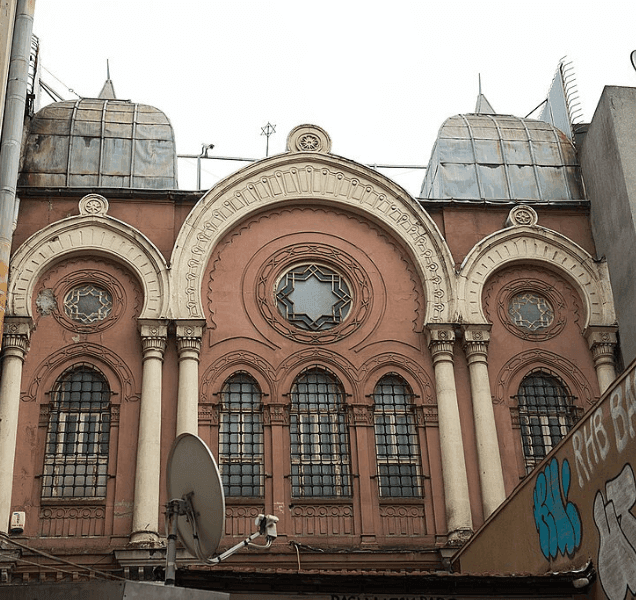
Havra Sokağı is an orientation point, not a promise that every doorway is open. The street and nearby blocks carry the traces of a dense religious and residential landscape. Look at the relationship between market stalls, courtyard entrances, upper-storey windows and narrow passages. The Ministry’s provincial guide notes that the buildings often sit within inward-looking courtyards, so a visitor may see relatively little from the street. This is a reason to prepare carefully rather than force access. Ask in advance which sites permit an interior visit on your chosen day, who can arrange permission and what respectful photography rules apply. A thoughtful exterior walk still teaches much about the neighbourhood’s structure.
Read several synagogues as distinct places
The provincial directorate names Şalom, Algaze, Sinyora Giveret, Bikur Holim and Etz Hayim among surviving Kemeraltı synagogues. These names should not blur into a single “old synagogue” stop. The ministry describes Şalom on 927 Street opposite Algaze; Sinyora Giveret faces both that street and Anafartalar Avenue. Such small spatial details help visitors understand a cluster rather than a checklist. If an interior visit is possible, ask your guide to explain the position of the prayer platform and the Torah ark, and which elements belong to later alterations. Avoid assigning a precise founding date to a building merely because its present form looks old. Current use and access must be confirmed separately.
Think about change within buildings
Historic worship spaces are rarely frozen at their founding moment. The ministry’s account of Sinyora Giveret describes a portable prayer platform moved toward the ark during a later redesign. Its description of Etz Hayim likewise records repairs after fires and an interior shaped by timber construction. These details matter because they prevent an easy picture of unbroken architectural sameness. A building can preserve a community’s memory while changing to meet practical needs. Compare what you can see today with the museum or ministry interpretation, and ask which features are documented, restored or inferred. If a building is closed, do not assume that an outside photograph can settle questions about its interior plan.
Keep worship and visitor access separate
A synagogue may be a heritage site and an active religious space. Neither a published tour description nor a travel article can guarantee admission on a given date. Community events, security arrangements, conservation work and religious observance can alter access. Plan through the relevant site or host, and ask what identification or advance contact is required before travelling. Dress and behave respectfully, keep group size manageable and follow local instructions about photography. If access is unavailable, replace the proposed interior with a street-level reading of the neighbourhood or another confirmed stop. Do not present the absence of an interior visit as a failure: respectful boundaries are part of how living heritage is sustained.
Compare Kemeraltı with Karataş carefully
Izmir’s Jewish history is not confined to Havra Sokağı. The provincial directorate also describes synagogues connected with later residential patterns in other districts. A route that adds Karataş may help visitors see a change in the city’s geography, but the two areas should not be squeezed together without considering travel time and access. Confirm each stop separately. A photograph of one façade cannot stand for the history of an entire community; look instead for differences in surrounding streets, building scale and date. If your available time is short, a focused Kemeraltı walk can be more rewarding than a rushed citywide survey. A longer day can give each district space for its own story.
Understand the UNESCO distinction
UNESCO lists the Historical Port City of Izmir on Türkiye’s Tentative List, a stage of consideration rather than a World Heritage inscription. Its description includes Kemeraltı, Basmane and Kadifekale and discusses mosques, churches, synagogues and commercial buildings within a wider urban fabric. This is useful context for understanding why Havra Sokağı cannot be separated from the working port city around it. It does not mean that every synagogue has an individual UNESCO designation or that the whole neighbourhood is managed as a museum. Read the tentative listing as an account of the city’s layered urban character, then return to the specific streets and buildings with more precise questions.
Plan with the published journey
CREAOS lists Izmir in its Jewish Heritage Tour of Türkiye alongside other cities. Use that itinerary as a starting point for a written proposal, not as proof that every synagogue named in a guide is included or accessible. Ask which Kemeraltı streets are planned, whether any interiors have been arranged, who will guide the visit and what time is reserved for the market district. Confirm transport, meals, admissions and the final price for your dates. If you want a route centred on Sephardic history, say so; if your interest is urban architecture, explain that as well. Different questions lead to different walks, even when they start at the same corner.
Leave room for the neighbourhood
The strongest memory of Havra Sokağı may be a relationship rather than a single façade: a courtyard threshold beside a busy market, an old name on a street sign, or the short distance between two distinct congregational buildings. Carry that observation into the rest of Izmir instead of treating the community as a closed chapter. Ask what the official descriptions can demonstrate and where they leave questions unanswered. Give active religious spaces their privacy and avoid turning residents into background scenery. A careful walk connects faith, architecture and commerce while acknowledging that the neighbourhood continues to change. That is a more useful travel story than a list of supposedly guaranteed entrances.