
İshak Paşa Palace: Reading Architecture and Landscape in Doğubayazıt
Explore the palace near Doğubayazıt through its courtyards, carved stone, varied working spaces and setting beneath the mountains of eastern Türkiye.
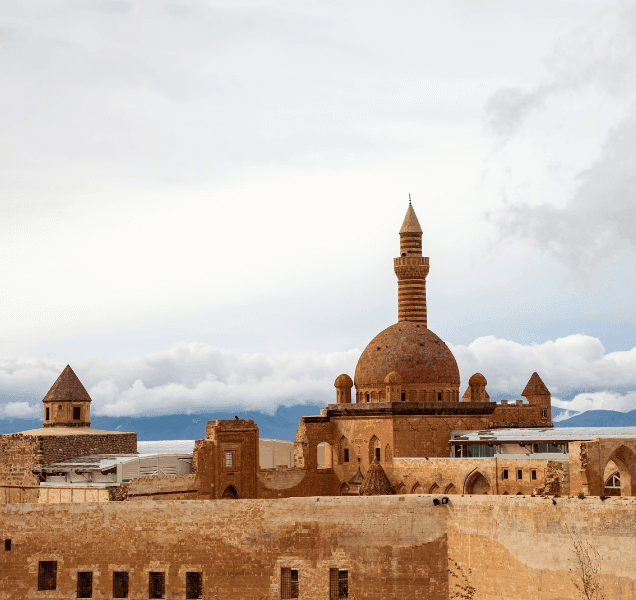
Look at the setting before the palace
For a traveller arriving in Doğubayazıt, İshak Paşa Palace is more than an elaborate façade. It rises on a hill outside the modern town and has a powerful relationship with the mountainous landscape around it. The official museum description places the complex east of Doğubayazıt. Before taking the first close photograph, step back and observe the approach: how does the road climb, where does the palace turn, and how do its walls meet the horizon? This guide is a way to read a stop on the CREAOS Eastern Anatolia route as a historical building. The dramatic panorama is a starting point for questions about rooms, courtyards and the people who used them.
Avoid a single simple construction date
Accounts of the palace do not always express its chronology in the same way. Even official summaries place language about the late Ottoman period beside references that can suggest other periods. It is safer to understand the complex as the result of construction and use over time than to present it as an unchanging design completed in one moment. A publication from the Ağrı Provincial Directorate of Culture and Tourism describes construction in stages. Do not assign a precise date to a wall merely because it looks older than its neighbour. Ask a guide or consult current museum interpretation when a detail matters to you. Admitting uncertainty is more useful than repeating a neat but unsupported timeline.
Treat the entrance as a threshold
Movement from the outside world into the palace is framed by a main entrance. The museum highlights its carved stone and relief decoration. Take time to see more than the surface detail. What does the gateway separate? What would someone entering have seen first, and which spaces remain concealed farther inside? An entrance to a palace is both a protective boundary and a device that orders movement. Photograph the craftsmanship without touching fragile stone. Changing light can make shallow reliefs appear different during the day, so one image may not capture every feature. Looking from both near and far helps you connect the visual spectacle of the doorway with the plan behind it.
Read the courtyards as working spaces
The museum record describes courtyards, meeting spaces and service rooms among the components of the complex. Calling every room simply a “palace room” hides this arrangement. As you move from one courtyard to another, consider who might have had access and what kinds of work were possible there. The scale of an open space and the positions of its doors offer clues to circulation, although architecture alone cannot prove every social rule. Read the on-site interpretation, then compare it with what you can observe. The palace becomes more than a photograph of a façade when you imagine people meeting, managing supplies, working and living across a sequence of spaces.
Notice worship beside everyday needs
The official museum lists a mosque, bath, kitchen, bakery, stables and other service areas. Together they point to the ordinary labour required to maintain a grand residence. At the mosque, think about worship; at the kitchen, food and supply; at the bath, water and heat. Do not assume every function is equally legible in the surviving fabric. Some spaces are easier to understand through a plan or interpretive panel than through a standing feature. Give time to modest rooms as well as richly decorated ones. The complex was shaped not only by a desire to impress visitors but also by the practical demands of housing, serving and organising people.
Do not reduce the stonework to one style
İshak Paşa Palace is often described as a meeting place of architectural traditions. The museum notes features associated with Ottoman and Seljuk styles. Treat that as an invitation to look carefully, not a formula for assigning every stone to one maker or dynasty. A carved gateway, a plain wall and ornament inside a room have different roles. Before naming a motif, ask where it sits and how a visitor was meant to see it. Similar decoration at another monument does not automatically prove that the two were made at the same time. Use the guide’s interpretation alongside institutional sources to connect attractive details to the wider history of the building.
Let Mount Ararat be geography
It is easy to use Mount Ararat as a picturesque backdrop when describing Doğubayazıt. Yet the mountain also affects the sense of direction and scale as you approach the palace. The related CREAOS Eastern Anatolia itinerary places a view of the mountain near the palace visit. Visibility depends on weather; no visitor should be promised an unobstructed view on a particular day. The region also carries beliefs and claims about Noah’s Ark. A travel guide should not present those claims as a confirmed archaeological discovery. Focus on the palace’s documented architecture and on the landscape actually visible to you. This makes the setting richer without turning an unverified story into a fact.
Leave space in your itinerary
Travel across eastern Türkiye can involve long road sections and changing conditions. Avoid reducing the palace visit to a guaranteed number of minutes or a promise about perfect photographic light. On the day of travel, consult the official museum page for hours, tickets and any temporary access notice. Ask how slopes, steps and stone surfaces may affect your own mobility. If travelling with a guide, say whether you would prefer more time in the courtyards and service areas. A slower look at a few parts may reveal more than a hurried pass through every room. Flexibility helps you understand the architecture and the setting together.
Carry three questions away
Three questions can guide a visit to İshak Paşa Palace: how does it occupy the terrain, how might people have moved inside, and what varied functions did the complex bring together? They leave a more lasting impression than a single entrance photograph. The CREAOS Classic Eastern Anatolia Tour places the palace in a wider journey through Van and Kars. A separate private Doğubayazıt journey offers another way to plan time around Mount Ararat; distinguish religious narratives from verified physical evidence. Confirm actual routes, inclusions, transport and current access before booking. As you leave, remember both the architecture and the landscape that gives it such a distinctive setting.