
Jewish Heritage in Istanbul: A Thoughtful Route from Galata to the Golden Horn
Understand Istanbul’s living Jewish heritage through Neve Shalom, the Museum of Turkish Jews, Galata and the Golden Horn neighborhoods.
Begin with a living heritage
Jewish heritage in Istanbul is not a handful of buildings left behind by an absent community. It is linked to worship, family life, languages, music, trade and neighborhood relationships that continue to matter to people today. A useful visit therefore begins with listening rather than searching for supposedly hidden sites. A museum in Galata, the religious life of a synagogue and streets around the Golden Horn present different scales of the same broad history. They cannot be reduced to one story. For a visitor, the guiding principle is simple: remain curious, but place the privacy and safety of the people who use these places ahead of a sightseeing checklist.
Start with the Museum of Turkish Jews
The Quincentennial Foundation Museum of Turkish Jews states that it opened in 2001 in the former Zülfaris Synagogue and moved to its present setting at Neve Shalom in December 2015. These dates illuminate a change in how heritage is presented: a museum that began in one former religious building now operates in a setting connected to an active synagogue. Its exhibitions address history, ethnography, religious objects, life-cycle traditions and places where communities lived. This offers vocabulary and context that a street walk alone cannot provide. Read the displays as a curated account based on chosen objects and documents, not as a claim to speak for every member of a diverse community.
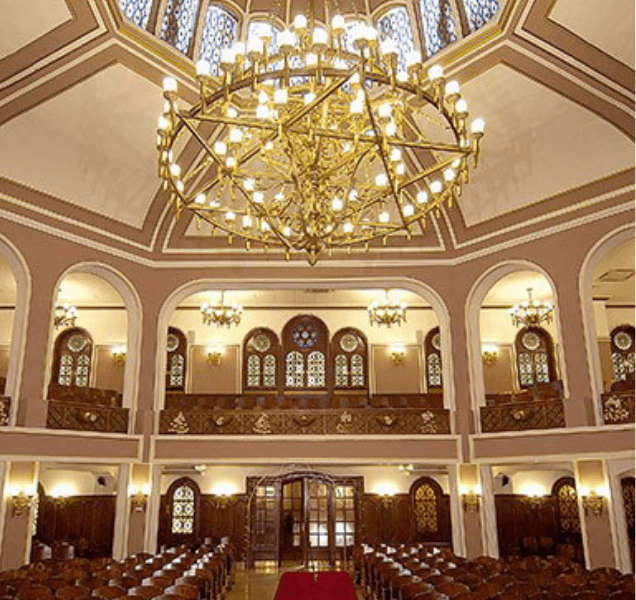
Understand Neve Shalom as a place of worship
The Neve Shalom Sephardic Synagogues Foundation records that Neve Shalom Synagogue opened on 25 March 1951. The date anchors a chapter of the community’s history, but architecture should not eclipse the building’s continuing religious role. Museum and synagogue are connected in location; they do not necessarily share the same visitor rules. Never assume that a museum ticket, an exterior view or an online photograph permits entry to every space. Ask the relevant institution about current admission, photography, identification and security requirements before you travel. Following its guidance is not an inconvenience added to the experience. It is part of visiting a place that matters to its community.
Read Galata without labeling every facade
Galata rewards a slow walk because streets, shops and religious buildings sit close together. Yet no facade should automatically be assigned to a particular group on appearance alone. A building’s use may have changed, and a reliable account needs documentary support. Notice the slopes, the passages between commercial streets and the routes leading toward the waterfront. These details help explain movement through the district without turning it into a static map of ethnic quarters. A knowledgeable guide should be able to distinguish a documented connection from an attractive but unverified anecdote.
Avoid flattening different traditions
The CREAOS Jewish Heritage Tour names both Neve Shalom and the Ashkenazi Synagogue among its possible points of interest. Their presence on one itinerary reminds visitors that Jewish life in Istanbul cannot be described through a single religious or cultural tradition. Differences deserve careful explanation, but they should not be reduced to food, clothing or a visual contrast between buildings. Museum interpretation and the institutions’ own materials are useful starting points. The experiences of people living in a community today are more varied than any travel article can fully represent. Treat each stop as an opening for more informed questions, not as one entry in a supposedly complete collection.
Continue toward Balat and Hasköy
The tour also proposes Balat and Hasköy, allowing a change of scale from a Galata museum to neighborhood streets around the Golden Horn. The purpose is not to label an entire district by the identity of some of its former residents. Schools, workplaces, worship spaces, housing and later changes all belong in the account. What a building once held and how it functions today are separate questions. Rather than speculating about what lies behind a closed door, rely on what can be observed from public space and what responsible institutions document. A route that does not disrupt residents’ routines can tell a richer story than a hurried search for access.
Photography, privacy and security
Religious heritage may inspire photography, yet rules at places of worship and security points can differ from those at conventional visitor attractions. Do not photograph interiors, staff or worshippers without explicit permission. On public streets, avoid making residents’ private lives into a visual souvenir. An object displayed in a museum cannot stand in for the full experience of a living community; reading its label and noting the context may be more valuable than taking another image. Check each institution’s own current guidance for appointments, identification and access on special dates. This article cannot guarantee entry. Planning respectfully is part of understanding the character of these places.
Build a realistic day
A thoughtful itinerary gives the museum and its immediate Galata context enough time before choosing additional stops according to interest and current access. The possibility of passing through Balat and Hasköy in one day does not mean that every named building can be visited. Istanbul traffic, hills, walking pace and the needs of active worship spaces can affect the plan. A fixed duration or guaranteed sequence should be settled only when a personal itinerary is agreed. Visiting the museum first can make later street observations more meaningful by supplying terms and historical context. A shorter route with time to pause is often stronger than a long list of exterior photographs.
Ask questions that deepen the visit
Beyond asking when a building was built, ask what evidence supports the story, who uses the place today and how the neighborhood has changed. Identify which connections between a museum display and a street are documented, and which are interpretations. Jewish heritage should not be isolated from Istanbul’s wider history: trade, migration and urban culture develop through interaction. Sensitive subjects call for sources and careful language rather than confident guesses. Where a fact is uncertain, an honest guide can say so. A visitor can contribute by listening, leaving space for others and refusing to treat living people as exhibits along a route.
Let the journey remain open
Istanbul’s Jewish heritage cannot be completed in a single day. Museum accounts and neighborhood walks complement one another, but none represents every voice. Remembering why questions matter is more useful than memorizing a few dates. The CREAOS Jewish Heritage Tour offers one way to frame the route; the Istanbul destination guide can help place it among other cultural areas. Confirm the actual program, possible visits and any special conditions with the team and institutions before booking. This guide suggests a respectful way to look; one walk cannot tell the whole story.