
Magnesia on the Maeander: From the Artemis Sanctuary to the Stadium
Explore the Artemis sanctuary, agora and stadium at Magnesia on the Maeander. Plan a visit near Germencik in Aydın.
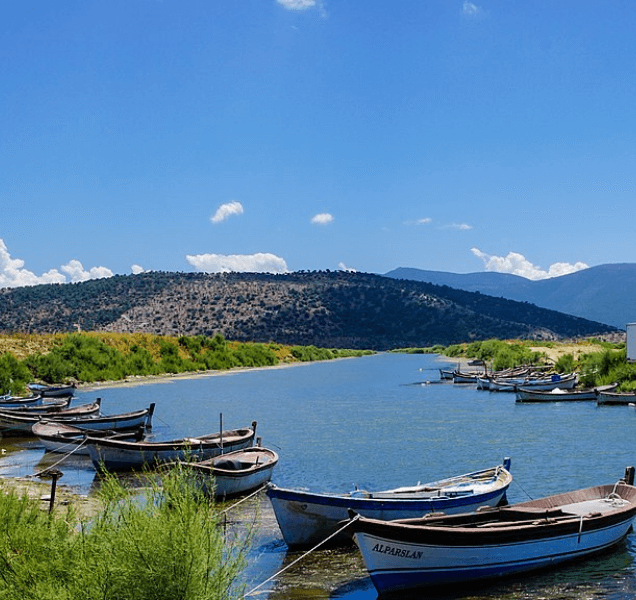
Magnesia on the Maeander is near Tekin in the Germencik district of Aydın, on the road between Ortaklar and Söke. Its most rewarding feature is the relationship between places that can seem quite ordinary when seen separately: an area of paving, an altar, a sanctuary and a public square. At Magnesia, you can spend a visit working out how these elements fit together. Bring a site plan if one is available and give yourself time to look across the ground before you start reading labels. This is a place where an empty stretch between ruins can explain as much as a fallen column.
Find the space in front of the temple
The sanctuary of Artemis Leukophryene offers a starting point. The Aydın Provincial Directorate of Culture and Tourism associates the Hellenistic temple with Hermogenes and identifies an earlier temple on the same ground. Today, the immediate challenge is to imagine how visitors would have experienced the building on approach. There is no need to reconstruct the whole roof or put every block back in position. Start by identifying where the front faced and where someone walking towards it would first have seen the building clearly.
The find that makes this exercise worthwhile lies outside the temple itself. Excavations uncovered a marble-paved ceremonial area between the altar and the agora. That position helps you understand the sanctuary as part of a public route. Think of the distance someone would have covered from the square before reaching the place of ceremony. Were they still in an open space? What new view might have appeared near the altar? The answers you can suggest from a map and the surviving ground are more useful for a first visit than trying to picture a specific procession in detail.
Read Hermogenes through the plan
A complicated architectural term can describe a simple spatial effect. The provincial account discusses the temple’s pseudodipteral plan, in which the outer columns stand well away from the inner building. When you can see that arrangement in a diagram, trace both outlines with your eye. Notice how much space lies between them. That interval would have changed the experience of moving around the building and the amount of shelter someone could find beneath the roof.
If you are travelling with a guide, ask to be shown one detail on the ground that can be matched with the temple plan. You might begin with the angle between two sides or a line of bases. For a group with differing interests, this gives architecture enthusiasts something specific to follow and everyone else a clear reason to stop. A wide photo of the ground and a second one of the detail can be more informative together than a collection of isolated fragments.
Give the agora time of its own
The agora was a public space. At Magnesia, its proximity to the sanctuary gives it an additional role for the modern visitor: it helps you see where everyday activity and ceremonial space met. Find the limit of the square before looking for individual buildings. Corners and changes in the direction of masonry are especially useful. At the sanctuary you might have focused on what lay straight ahead. In the agora it is worth turning in several directions to see what the space connects.
The Ministry’s account records excavations at the agora, the Artemis temple and altar, the theatre and the temple of Zeus. It can help to choose one area as your reference on the visit. When you reach another, try to remember which side you approached from. If the layout is difficult to follow, sketch a square, a line and a second rectangle rather than attempting a complete map. It is enough to remember the relationship between the spaces you actually examined.
Compare public space with spectator space
The ancient stadium is another stop on CREAOS’s published route and an opportunity to compare different kinds of large space. An agora invites people to move across it and between surrounding buildings. A stadium directs attention down its length. Where the day’s visitor route lets you see it, first look for the shape of the space and the way the seating relates to it. Be guided by barriers and directions at the site when deciding where to go.
The comparison also works when you have limited time or uneven walking conditions. Spend longer at the sanctuary and agora if your main interest is architecture, or make the stadium your additional stop if you want to think about audiences and events. When travelling with children, ask them to find a place where a person would once have stood still and another where someone would have kept moving. You will have a small set of observations to discuss without needing to see every corner of the excavation.
Decide how much to fit in after Magnesia
CREAOS includes Magnesia on its Magnesia, Latmos and Lake Bafa itinerary. Read the Lake Bafa and Latmos guide if you are considering a second stop: it helps you judge how different that landscape visit will feel after an archaeological site. If the temple and stadium are priorities, ask for time at Magnesia before agreeing on the rest of the route. Check the Ministry’s visitor information and ask about walking surfaces and access to the areas you most want to see. Bring water for time outdoors and plan an easy alternative if one part of the route is unsuitable on the day. Before leaving, identify the one view that best explained the city to you. It may be the view between the altar and the agora, where the arrangement of open ground is still legible.