
Reading Aphrodisias in Marble: Tetrapylon to Sebasteion
A closer look at Aphrodisias through its carved gateway, imperial reliefs, sculpture workshops and museum, with practical notes for a thoughtful visit.
Start with the material
Aphrodisias is often added to a multi-stop itinerary as another ancient city. That description misses its particular strength: the relationship between nearby marble, skilled carvers and the stories a city chose to display. UNESCO identifies the archaeological site and the quarries northeast of it as the two components of its World Heritage property. The stone was not merely a building supply. Portraits, architectural ornament and carved reliefs helped shape the city’s reputation in the Roman world. Begin your visit by asking how material, workmanship and public setting interact. This gives a more useful thread than trying to memorise every monument at once.
Approach the Tetrapylon slowly
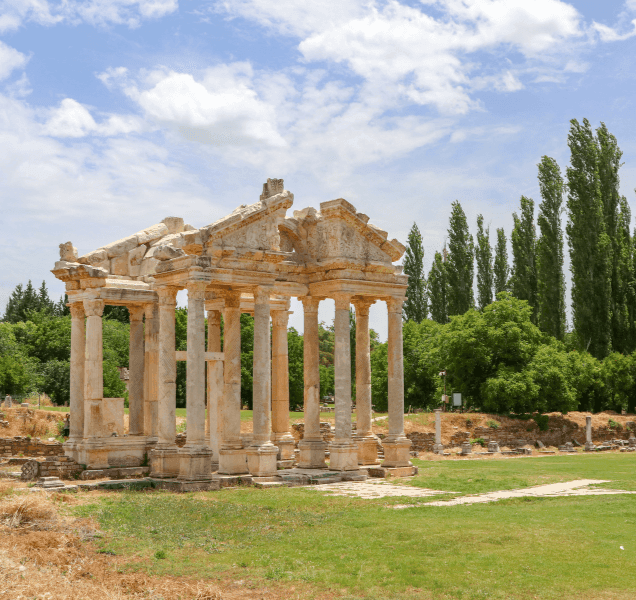
The Tetrapylon is the conspicuous entrance to the outer sanctuary of Aphrodite. Its columns and carved upper elements make an immediate photograph, but the question is what an entrance does. Stand at a distance first and see how it directs the eye. Move closer to compare ornamental detail, then look past it towards the sanctuary landscape. UNESCO highlights the richness of the gateway’s carving without treating every surviving element as an untouched record of one moment. Archaeological sites are studied and conserved over time. Resist the temptation to reconstruct an entire ancient procession from a single view; use the gateway as an invitation to ask how people moved through the city.
Separate the goddess from the empire
The sanctuary and the Sebasteion answer different questions. Aphrodite was central to the city’s name and cult traditions; the Sebasteion was an elaborate complex associated with worship of Augustus and the Julio-Claudian emperors. UNESCO describes its sculptural programme as a meeting of Hellenistic, Roman and local Aphrodisian traditions. These are related parts of the same civic landscape, not interchangeable labels for one temple. Read the reliefs as deliberate choices about identity, myth and imperial power. A guide can explain how the figures were arranged; if an interpretation is uncertain, keep that uncertainty visible instead of presenting it as a confirmed scene.
Look for a city of sculptors
Aphrodisias was a centre for marble carving, not simply a place that owned finished statues. UNESCO points to its quarries and excavated sculpture workshops as evidence for production as well as display. That distinction changes what you notice. Tool marks, unfinished work and repeated forms can be as informative as a polished face. The reputation of Aphrodisian artists extended beyond the city, yet no visitor should assume that every marble object across the Roman world came from this one workshop. Consider the chain of labour: obtaining stone, transporting it, designing a form, carving it and placing it where someone would encounter it.
Give the museum real time
Aydın Provincial Directorate of Culture and Tourism describes the Aphrodisias Museum as a home for sculpture, reliefs and sarcophagi found during excavations. The museum allows a different kind of attention from the open-air walk. You can compare expressions and carved surfaces at closer range, and see how pieces from separate contexts are presented together. Do not use the displays merely as shelter at the end of a rushed circuit. Choose a few objects and ask what can actually be inferred from their labels. Some reliefs associated with the Sebasteion are best understood by connecting their museum presentation with the remains outdoors. Check current opening and access arrangements before setting out.
Read the theatre and stadium as civic spaces
The monumental gateway is not the whole city. UNESCO also notes the theatre, an archive wall bearing official imperial documents, and a stadium with a distinctive form. These structures suggest different public activities and different audiences for carved messages. An inscription in the theatre speaks in a different register from a mythological relief or a ceremonial entrance. If your time is limited, choose one additional civic space and compare it with the Tetrapylon rather than hurrying through every landmark. Notice scale, sight lines and the relationship between seating or passageways and the surrounding landscape. The ruins do not give a complete account of daily life, but they make better questions possible.
Keep the chronology layered
UNESCO dates the temple of Aphrodite to the third century BCE and describes later development of the city. The temple was transformed into a cathedral around the sixth century CE. This long sequence is a reason to avoid speaking about Aphrodisias as if every stone belonged to a single Roman afternoon. A reused space can carry a new religious meaning without erasing every earlier trace. When a guide points out a change in alignment or fabric, ask what archaeological evidence supports the proposed date. Avoid treating a modern conservation choice as ancient work. Reading layers carefully is more rewarding than turning a complex place into a simple before-and-after story.
Plan a route with realistic priorities
Aphrodisias can be paired with Laodicea and Pamukkale in a longer CREAOS journey, but those places deserve distinct explanations. Their current visitor arrangements, travel times, entry fees and route order should be confirmed for your date. If sculpture is your main interest, protect time for the Tetrapylon, Sebasteion and museum rather than reducing Aphrodisias to a quick roadside stop. Bring water and suitable footwear for an exposed archaeological site, and discuss mobility needs with the team before confirming a private programme. Read the published tour inclusions rather than assuming that a museum entry or meal is covered by the headline price.
Leave with a sharper question
A successful visit may not end with a complete catalogue of monuments. It may leave you asking who selected a relief subject, how a block travelled from quarry to workshop, or why a gateway remained meaningful after the sanctuary changed. Compare the CREAOS Aphrodisias–Laodicea–Pamukkale tour with its Pamukkale destination page to decide whether this marble story deserves a dedicated place in your journey. The official museum and UNESCO descriptions provide a starting point; direct checks remain necessary for present-day access. Look back once more at the gateway before leaving. Its beauty becomes richer when you have thought about the labour and changing city around it.