
Reading Ottoman Tombstones in Istanbul: Eyüp to Süleymaniye
Explore Eyüpsultan, Fatih and Süleymaniye burial grounds with care, reading inscription, form and setting without turning remembrance into spectacle.
Enter as a guest, not a collector of images
Istanbul’s Ottoman tombstones are surviving documents in stone, but the places around them remain settings of remembrance. In Eyüpsultan, near Fatih Mosque or at Süleymaniye, begin by asking how to visit respectfully. Do not cut between graves, lean on a marker or make a person at prayer the background of a photograph. This guide reads the stops of the CREAOS Istanbul Ottoman Tombstones Tour as a route through inscription, form and urban setting. You do not need to decipher every line to learn from a stone. Its scale, position and visible carving can raise useful questions, while an inscription may provide a name or date when it is legible. None of these elements tells a complete life story by itself. Knowing that limit makes the experience more historically careful and more considerate of those who come to remember family or to worship.
Read the burial ground before the marker
A hazire is a burial ground associated with a mosque or another institution, often enclosed by a wall. If you focus only on individual stones, you may miss why they stand in this place. Notice the entrance, the relation to the prayer space and the surrounding streets. The Fatih District Governorship describes Fatih Mosque within a larger külliye, a complex connected with education, charity and other public functions. Its memorial landscape belongs within that wider history. Do not assume the present building fabric and every marker arose at the same moment; Istanbul’s structures have been repaired, rearranged and reused. A guide may not be able to identify the original position of each stone from reliable records. Acknowledging what remains uncertain is more useful than assigning a confident but unsupported story to a weathered inscription.
See the scale of Eyüpsultan
Eyüpsultan Municipality presents separate inventories of local cemeteries and tombs, a reminder that the district’s memorial landscape is not one small enclosure. Its catalogue for Mihrişah Valide Sultan Cemetery lists individual numbered stones and names. Consult it before a visit if you are interested in one example, but do not assume every number will be easy to locate on the ground. At Eyüp Sultan, the value lies not only in prominent mausoleums but in the traces of many lives across different periods. Take note of the layout of a readable inscription, the shape above it and where the marker stands. If you cannot read Ottoman script, do not improvise a translation from a decorative flourish. Return to a verified catalogue or ask a guide who can distinguish documented information from an educated possibility. Keep paths clear for people visiting graves or attending worship.
Treat a headpiece as a clue, not proof
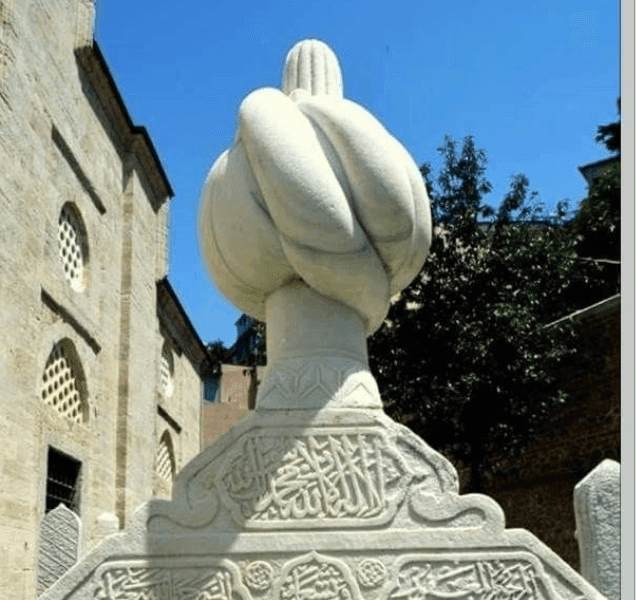
Some Ottoman grave markers carry shapes that recall a turban, a kavuk or a fez. These forms can suggest a period or social context, but shape alone cannot securely establish a person’s occupation, rank or identity. An Eyüpsultan municipal publication illustrates different headpieces and discusses how their use changed. The inscription, date, ornament and condition of the stone must be considered together. A headpiece may be damaged or missing, and later repair can complicate interpretation. Ask your guide what a form usually suggests, then ask what evidence supports that reading in this particular case. A popular chart that assigns one exact profession to every shape is too simple for a varied historic landscape. Careful uncertainty does not lessen the beauty of the carving; it helps preserve the distinction between an observable feature and a claim about a person.
Let the inscription remain a document
A tombstone text may include a name, title, prayer or date, but examples do not all follow one formula. Lettering, framing and surface wear affect what can be read. Do not rub a stone with paper, apply chalk or touch fragile carving to make a line clearer. Digital enlargement and authorised catalogue photographs are better tools. Türkiye’s Directorate General of Cultural Heritage and Museums has described the return of Ottoman tombstones taken abroad. Its account makes clear how removal can sever an object from the place that helps explain it. Even a fully legible inscription is more meaningful when you consider its location and neighbouring memorials. If a word is lost, leave it unresolved rather than turning a guess into a biography. The gaps in a record are part of responsible historical reading.
Connect Fatih to the wider complex
At Fatih Mosque, remember that a külliye served more than one purpose. The district authority links the mosque to institutions such as schools, food provision, libraries and baths. The burial ground sits within this wider social and architectural context. Look beyond famous names: a modest marker may reward attention to lettering, carving or material, although these observations alone will not supply a reliable date. If worship continues during your visit, follow local rules for access, dress and photography. Check current conditions before planning to enter a particular mausoleum. The Fatih stop is valuable because the living city, the institutional complex and the memorial space remain close to one another. You can learn from their relationship even if you do not understand every inscription.
Distinguish the scales at Süleymaniye
Süleymaniye’s hillside setting and broad views can distract from the small details. First look at how the burial ground relates to the mosque and other buildings. The Fatih District Governorship identifies the tombs of Süleyman the Magnificent and Hürrem Sultan separately in this complex. Do not let their monumental presence erase the smaller markers nearby. A mausoleum is an architectural space; a headstone often concentrates remembrance in text and carved form. Nearby memorial sites should be identified by their actual position rather than assumed to be inside the mosque garden. That distinction between nearby and inside matters when navigating the site. Use the different scales to ask what is commemorated publicly and what survives in a quieter form. Avoid declaring that every stone around a famous tomb belongs to the same household or period.
Confirm the route in writing
The CREAOS Istanbul Ottoman Tombstones Tour links Eyüpsultan, Fatih and Süleymaniye as a starting point for this kind of visit. Confirm the final stop order, meeting place, transport and any interior access in the written proposal for your date. Comfortable shoes and a modest photography plan help on streets with changing surfaces. Tell the team about mobility needs and whether you want more time with a particular inscription. For a different view of the peninsula, compare the CREAOS Private Istanbul Old City Tour, which focuses on major monuments rather than memorial stones. The two experiences should not be assumed to share the same inclusions. At the end, the most valuable memory may be a better understanding of how a city commemorates its people and how we can approach that heritage today with curiosity and care. The itinerary also names the tomb of Sultan Abdülhamid II; confirm access and nearby marker identities.