
Sardis Beyond a Single Era: Artemis, Synagogue and Bin Tepe
Explore Sardis through its Lydian city, layered Artemis sanctuary, later synagogue and Bin Tepe burial landscape with a careful, practical route.
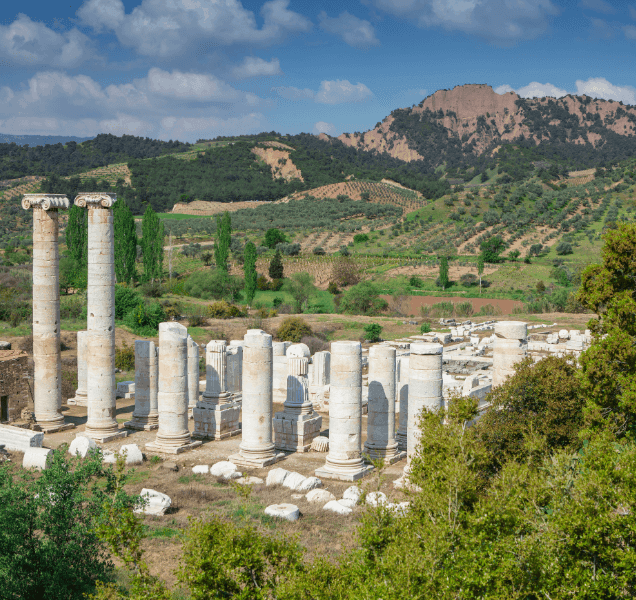
Read the city in layers
Sardis rewards a visitor who resists a single-label account. It was the capital of Lydia, but the columns and courtyards visible today also belong to later Greek, Roman and Byzantine histories. UNESCO inscribed Sardis and the Lydian Tumuli of Bin Tepe on the World Heritage List in 2025, recognizing a wider landscape rather than one photogenic ruin. Begin by locating the ancient city at the foot of the hills and considering how a fortified centre, lower settlement and burial ground related to one another. The best question is not simply what stood here first, but how successive communities changed the place while preserving traces of those before them.
Look closely at the Artemis sanctuary
The Temple of Artemis is a useful place to slow down. The Sardis archaeological expedition explains that construction began in the Hellenistic period, while alterations and additional columns belong to Roman phases. The building was never completed in the form its designers imagined. Rough surfaces and unfinished elements therefore tell a construction story as well as a religious one. Two standing columns have survived since antiquity, according to the expedition. Look at the difference between their finished surfaces and work left incomplete elsewhere. This is an Anatolian sanctuary with a long history; calling the entire surviving monument simply a Roman temple would erase the earlier phases and the decisions made over centuries.
See change rather than replacement
Artemis did not stand for one unchanging practice across the city's history. The excavation team notes an earlier sanctuary, a Hellenistic temple, Roman changes associated with imperial worship and a small church added near the temple in late antiquity. Each statement belongs to a different kind of evidence: inscriptions, architectural joints, excavated objects or later building remains. A guide can make those transitions legible without turning them into a simplistic story in which one community vanished overnight. Notice where blocks were reused and where new walls changed the room's purpose. Religious history here is a sequence of adaptations in a living urban landscape, not a row of isolated monuments.
The bath, gymnasium and synagogue
The monumental bath and gymnasium complex offers another perspective on Roman Sardis. The Turkish Museums description distinguishes a courtyard used for athletic activity from vaulted bathing spaces and the marble court connecting them. Close by, the synagogue reveals a Jewish community within the later city. These buildings are important precisely because they widen the narrative beyond Lydia's royal past. Ask which parts are ancient fabric and which have been reassembled or conserved for visitors. A reconstruction can help the eye understand a building's scale, but it also represents a modern interpretation. Allow time to read site labels before assuming that every column stands exactly where it did in antiquity.
Place the Christian connection carefully
Sardis is also named among the seven communities addressed in the Book of Revelation. That textual connection makes the site meaningful to travellers following Christian history, yet it does not turn every surviving building into a first-century church. The visible temple, synagogue and bath complex have their own dates and purposes. If faith heritage is your focus, ask a guide to identify what the text says, what archaeology establishes and what remains a later tradition. An honest distinction can deepen a visit: it shows the variety of religious communities that inhabited Sardis over time. CREAOS includes Sardis in its Asia Minor Churches route, whose final stops should be confirmed before booking.
Understand Bin Tepe from the landscape
The World Heritage property includes the Lydian burial mounds of Bin Tepe as a second component, separate from the main archaeological city. UNESCO records more than a hundred tumuli in that cemetery and notes that some are among the largest in the world. Their scale conveys the political and social ambitions of the Lydian elite, but they are not an extension of the temple forecourt. Study a map before setting out and treat the burial landscape as a distinct stop if it is included in your proposal. Access, roads and conservation restrictions can affect what is appropriate to visit; never assume that every mound is open to enter.
Plan a route around your interests
A thoughtful Sardis visit can begin with the Artemis sanctuary, then turn to the bath, gymnasium and synagogue before discussing the Lydian city visible and buried around them. Another group may prefer to start with the city plan and give more time to Bin Tepe's setting. The useful order depends on the current site access, weather, walking ability and where the guide meets you. Ask for the exact stops, admission arrangements and expected time on foot in a written itinerary. The published tour describes a wider circuit of the churches of Asia Minor; it should not be read as a promise that every Sardis structure, or every burial mound, is included on a particular day.
Travel with practical care
The archaeological site is exposed to the weather, and uneven ground may matter more than the distance on a map suggests. Bring footwear suitable for outdoor paths and ask about shade, steps and resting places if anyone in your group has mobility concerns. Check official museum information shortly before travel for current hours, tickets and any closed sections; these can change. Keep a little flexibility for looking at interpretation panels instead of rushing between famous names. Do not climb fragile masonry or enter restricted areas for a photograph. Conservation is part of the reason the place can be interpreted at all, and the UNESCO inscription makes that responsibility especially visible.
Leave with a fuller history
Sardis is often introduced through Croesus, gold or a biblical reference. Each opens a door, but none tells the whole story. The terraces and burial mounds speak to Lydian planning; the Artemis sanctuary shows long architectural change; the bath complex and synagogue reveal later urban communities. Try to leave with one observation from each layer and one question about how archaeologists know what they claim. Compare CREAOS's Asia Minor Churches journey with the broader private Turkey tours collection if you are shaping a multiregion itinerary. A good visit makes the city's different histories intelligible without forcing them into one legend or treating uncertain details as settled fact.