
The First Council of Nicaea: What Happened in İznik in 325?
Explore the decisions of the 325 council, the difference between the meetings of 325 and 787, and how to read their history in modern İznik.
A city larger than one date
Walking through İznik, the year 325 can seem to hover over every street. Ancient Nicaea hosted a gathering whose name remains attached to one of Christianity’s best-known professions of faith. Yet it would be misleading to call every surviving stone a witness to that meeting. The gates, the central Hagia Sophia–Orhan Mosque and the lakeshore tell stories from different centuries. This guide separates the questions addressed by the First Council, the reason its decisions still matter and what a traveller can responsibly say while standing in the modern town. The point is to connect an event to a place without pretending that every historical detail has a visible monument.
Why gather in 325?
Christian communities across the Roman Empire were growing in the early fourth century, while disagreement persisted over central matters of teaching. The relationship of Jesus Christ to God the Father was not treated as a small matter of wording. Emperor Constantine convened bishops at Nicaea. Türkiye’s submission for İznik on UNESCO’s World Heritage Tentative List describes the meeting as a decisive event drawing participants from different parts of the empire. It was a religious council that also reflected a search for cohesion across an imperial landscape. Ancient accounts do not make a simple, uncontested attendance register. Rather than repeat one precise number as certain, it is more useful to understand the meeting’s broad geographical scope.
The question at its centre
The issue most closely associated with the First Council concerns Christ’s divine status. Against the position linked to Arius, the profession of faith affirmed that the Son is of the same substance as the Father. The Greek term usually transliterated as homoousios became central to this formulation. It shows why the debate was more than a political quarrel over titles: it shaped how Christian communities expressed belief in worship and teaching. A Vatican reflection on the council’s anniversary highlights the importance of this language. It would be inaccurate, however, to suggest that every participant immediately agreed on every implication or that subsequent disputes ended in one sitting. The council was a turning point in a longer conversation.
The creed used today has a history
Many churches today recite a text casually called the Nicene Creed. One small distinction makes the history clearer. The Catholic Church’s official catechism attributes the authority of the Niceno-Constantinopolitan profession to the first two ecumenical councils, Nicaea in 325 and Constantinople in 381. The entire text familiar to a modern congregation should therefore not be presented as a verbatim transcript of a single day in 325. A careful description says that Nicaea set out a foundational formulation and a later council formed another stage in its development. This does not lessen Nicaea’s importance. It helps visitors see both continuity and change in an expression that travelled far beyond the city where it began.
What about Easter?
The First Council is remembered for more than a statement of belief. A shared approach to celebrating Easter was also part of its work. The İznik Tentative List submission to UNESCO notes that effort. This does not mean that every Christian community now celebrates Easter on the same date. Calendars and methods of calculation developed differently in later centuries. Discussing the question during a visit can make a distant council feel close to lived experience. Decisions about a feast touch the yearly pattern of worship, the days on which communities gather and the memory they pass to the next generation. The issue links theology to ordinary time without requiring a visitor to master every later calendar dispute.
Where did the first meeting take place?
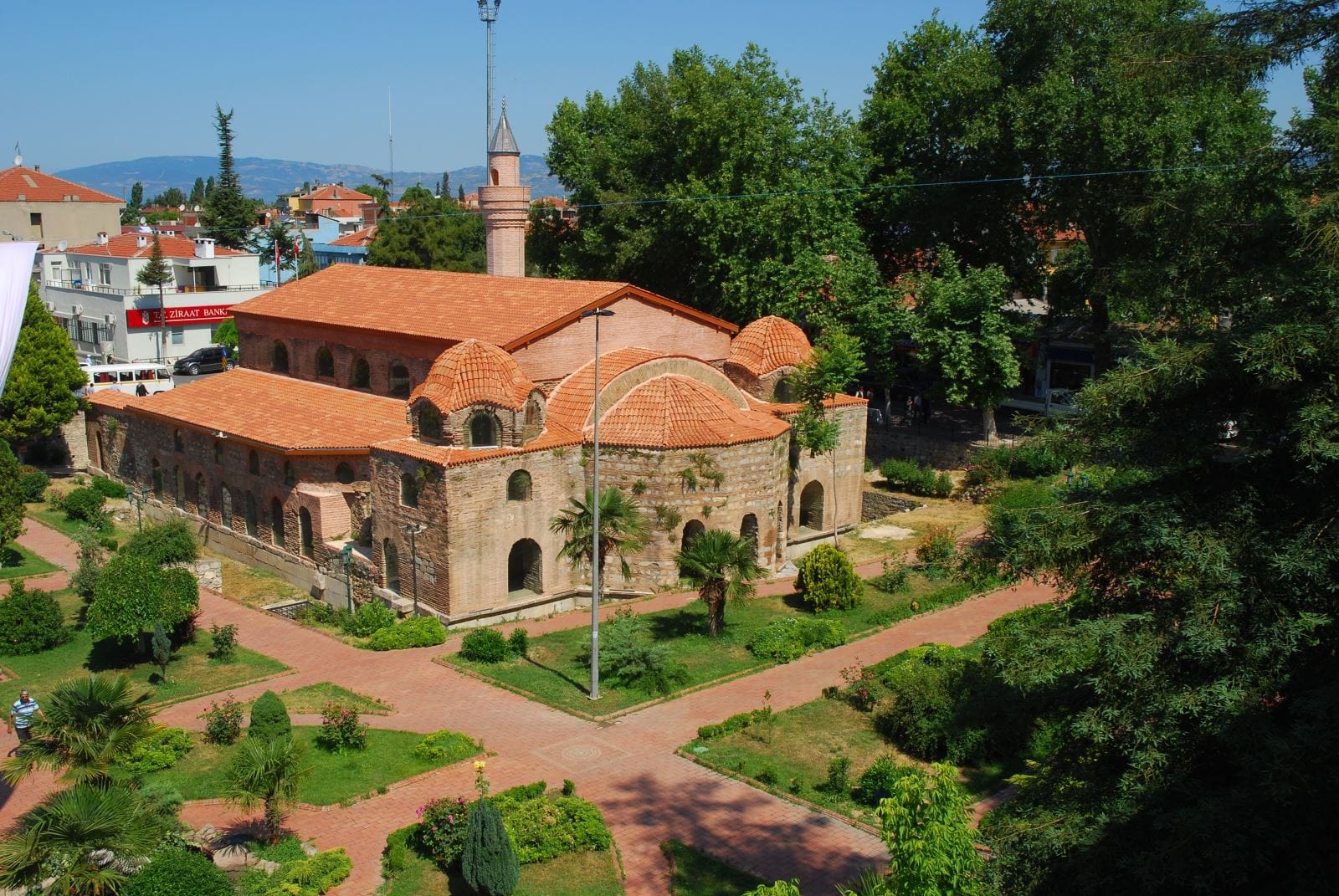
One of İznik’s most persistent confusions concerns the venue. Türkiye’s Ministry of Culture and Tourism associates the First Council of 325 with the Senatus Palace. The Hagia Sophia in today’s town centre is identified in the İznik UNESCO submission as the setting of the Seventh Ecumenical Council of 787. Standing before Hagia Sophia and saying that the first council met in this building merges two separate events. Nor should a guide identify the precise boundaries or surviving fabric of the Senatus Palace for today’s visitor without supported archaeological evidence. The association of the council with Nicaea is secure; a confidently mapped and fully visible meeting room is a different kind of claim.
Why 787 matters too
The Seventh Ecumenical Council met in Nicaea many centuries after 325 and addressed a different dispute: the use and veneration of sacred images. The UNESCO submission connects the gathering with Hagia Sophia and describes its significance for icons. This is the date to keep in mind at the present Hagia Sophia–Orhan Mosque. Later repairs and its conversion to a mosque after the Ottoman conquest are also part of the building’s history. Distinguishing the two councils does not diminish either one. Each has its own central question, its own century and its own setting. The name Nicaea links them, but it should not erase the long life of the town between them.
How to read the streets
Begin a historical walk at a gate or section of the city walls. The routes they frame remind us that Nicaea was a working settlement before it became the name of a council. Continue toward the central Hagia Sophia–Orhan Mosque, keeping the meeting of 787 and the building’s later transformations distinct. Finish by Lake İznik and consider the larger landscape. UNESCO’s account of the town stresses the relationship among settlement, water and agricultural land. This is a suggested way to read the place, not a promise that every monument is open on a given day. Check current guidance from the institutions responsible, especially where a building serves as an active place of worship.
Leave with two clear distinctions
The importance of Nicaea is not that every theological question was settled forever in 325. The city became a defining meeting place in the effort to express a common Christian faith. Modern İznik also contains the memory of a different council in 787, buildings shaped by Byzantine and Ottoman centuries, a ceramic tradition and daily life beside the lake. Take away two clear distinctions: the councils of 325 and 787 were different gatherings, and the creed widely used today is best understood through the historical relationship between the councils of 325 and 381. Those distinctions allow a more respectful account of both the city and the many communities for whom its history still matters.