
Perge Ancient City: From the Southern Gate to the Agora
Walk Perge’s colonnaded avenue near Antalya, read its gate, agora and baths, and compare the theatre and stadium before planning your visit.
From the remains of Perge’s southern entrance, the ancient city first appears as a set of fragments: towers, stretches of pavement and columns that no longer support a roof. Walk a little farther and the fragments begin relating to each other. The passage through the gate establishes a direction. A long street carries that direction into the city, while the agora and baths show what people could do once they arrived. For a first visit to this site in Antalya’s Aksu district, those connections make a better starting point than a catalogue of monuments.
Begin with the southern gate
The entrance is a good place to think in layers. The archaeological description submitted by Türkiye for UNESCO’s Tentative List identifies the southern round towers with the Hellenistic city walls. Architectural additions and changes continued in the Roman period. Rather than give everything in the entrance area one date, look at how separate elements mark the passage between outside and inside. A rounded tower presents a different face to the approaching visitor than a column alongside a street. Each manages the way people approach and enter.
Take a moment to look back once you pass a gate. It is easier from there to judge the width of the opening and see how it frames the ground behind you. A guide or a site plan can help distinguish surviving masonry from reconstructed elements. If your group is short on time, looking at the gate from both directions is more revealing than simply photographing it from the first viewpoint.
Use the long street to understand Perge
The Ministry of Culture and Tourism describes two main axes, one running north to south and the other east to west. That layout gives you a way to navigate the archaeological area even when the buildings are hard to identify. Look first in the direction of the paving, then along the line of column bases. The first shows where people moved. The second helps you picture an edge to the street, where walking beside buildings would have felt different from crossing the open centre.
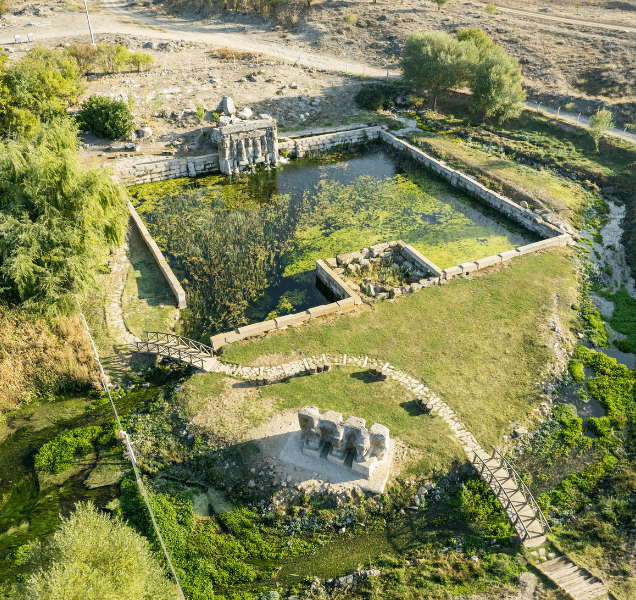
Perge’s long north–south avenue also preserves a channel along its central line. Seen dry, it is still an architectural feature worth reading. Its position divides the width of the street and leads the eye toward the far end. Photograph it from an angle where you can see both sides of the road. Later, that frame will show the relationship between water and movement more clearly than a close-up of one piece of stone. Stay on the marked visitor route as you look for that viewpoint.
Compare the agora with the baths
At the agora, change the scale of your attention. The street invited movement along a line, while the rectangular agora drew movement around and across a defined space. Look for the boundary before trying to picture what happened inside it. An edge with repeated openings is a useful clue to how people would have entered, paused and met. See whether you can find a corner where the outline becomes clear, even if little of the original height survives.
The baths ask a different question: how do you move through a building when its roof is gone? Walls, doorways and the relative size of the surviving rooms offer some clues. Start with the largest volume you can see, then trace the connections to smaller spaces. Reconstructing where a person could walk is enough to make a visit worthwhile. The purpose of any particular room is something to check against site signage or ask a guide about, especially where several building phases are visible together.
Set aside time for the theatre and stadium
The theatre and stadium are separate public buildings, and comparing their shapes explains why both are worth seeing if the route allows. The theatre draws your attention toward a stage, with the seating curving around it. In the stadium, the outlines are extended along a much longer space. The Ministry’s account also connects marble works found in the theatre with the Antalya Museum collections. It is worth learning about the objects even if you are unable to see them during the same trip.
Before deciding which building to spend longer at, ask what can be viewed on the day and how it fits your route through the site. If you visit as a family, invite everyone to pick one architectural detail and explain what it might tell you about a spectator’s view. The comparison works from a distance and keeps the focus on what you can actually see.
Plan a visit around what interests you
For a compact visit, make the gate, avenue and one adjoining public space your core route. That sequence gives you the relationship between an entrance, a street and a destination inside the city. Add the theatre or stadium if your group is comfortable with the additional walking and the day’s visitor route allows it. Questions about uneven ground, distances, shade or stepless access are best raised in advance. The official site listing is a sensible starting point for checking current visitor information.
CREAOS lists Perge on its Footsteps of Saint Paul itinerary, where the ancient city forms one part of a longer journey through Türkiye. The related route guide explains how Perge fits into that context. If you chiefly want to understand the excavation, tell the team that the gate, street and civic spaces are your priorities and ask for an itinerary with time for them. At the end, turn back toward the avenue once more. You’ll have a clearer idea of how the city was put together and what each part did for the people who used it.